Posts tagged ‘Writing’

January 13, 2012

Wise Blood a Novel by Flannery O’Connor

When it occurred to me I’d never read Wise Blood by Flannery O’Connor, I felt I’d be missing something if I didn’t. I’d read a book of her short stories and saw the movie of Wise Blood long ago so perhaps I imagined I’d read it. I’d never knowingly substitute the movie for the book. It is an amazing book. A minor annoyance is wading through the dialect-spellings she uses, but beyond that the book is a marvelous mix of clear writing and language with its impenetrable yet vivid characters.

Well, the characters are impenetrable at first, but also beautifully whole and unique. Mostly, though, they are as mesmerizing in themselves as mysteries which need solving. She does not supply easy answers for that. Through all this she creates a world both of this world and apart from it. I cannot put it down (except to write this review). The story has so taken root in my head, I couldn’t think of another book to mention from the past year.

December 28, 2011

How Bravery Failed in Hemingway and Fitzgerald

I just finished re-reading A Moveable Feast, by Hemingway. The edition is one that was restored from its earliest version but it does not restore Hemingway himself to “Great Writer” status. The novel or memoir (or both) tells tales of writers in Paris in the 1920s without the humor or drama that Woody Allen does in “Midnight in Paris.” To me, his short work such as The Nick Adams Stories show an early brilliance that his novels and later work could never match. In Moveable Feast you can watch him wobble between that brilliance and his clumsy attempt to bully his way through the story.

Two topics: one each about Ezra Pound and Gertrude Stein are the best of the bunch. In these two he does not appear to be in direct competition with his subjects. To Hemingway, it would seem, Stein is a woman so she offers no macho competition though she is easily his intellectual equal and mentor. And Pound is merely a poet who cannot match Hemingway in a boxing ring, so he requires no bullying either. In the section on F. Scott Fitzgerald, however, you can see how hard he competes. Most of the section is wasted with Hemingway spending too much time arguing how much worse a drinker is Scott than himself. Who wins that one? And who cares? Where are the great chats about writing we hope for? There one delightful small chapter on his use of first-person narrative, but it only highlights the lack of writerly tales.

Hemingway finally admits how “fine” a novel The Great Gatsby is, but he tags that with the prediction that because of Zelda, Fitzgerald could never match it after that. While it’s true that Fitzgerald never equaled that novel, it was not because of Zelda. According to Hemingway’s own statements that period of his own life also saw the dissolving of his marriage to Hadley, but you won’t find any of that in the text. The worst of it is a tedious discussion between the two men about the size of Scott’s manhood, the sub-text implication behind the story is the opposing size of Hemingway’s pen. Apparently, Hem had never heard the expression, T.M.I. and neither had his publisher. Finally, however, what felled Fitzgerald was also what felled Hemingway—a lack of writerly courage—which they covered up with their use of alcohol. Neither won that battle, and as their readers, neither do we.

I wish I could hold in my mind the foggy memory that I had after the first reading of the book (it was the sixties, you know) rather than have it sullied by this rereading. Something every reader knows is that fiction creates the best memories, so I will choose to “remember” Paris in the 1920s as Woody Allen has dramatized it in “Midnight in Paris.” Memory has always been my own best editor to me in life, but I pray never to be above any good editor of my own writing.

December 15, 2011

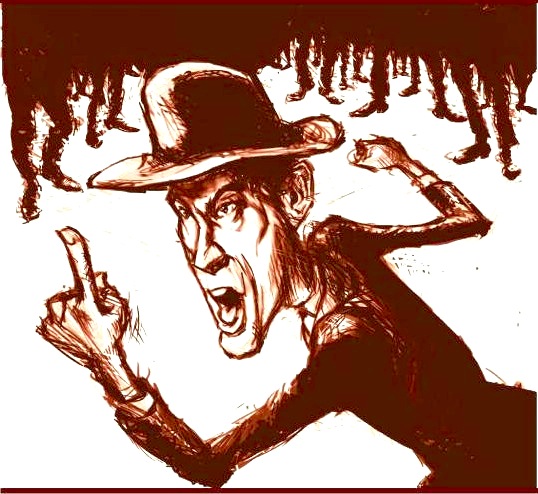
“Neither a panster nor plotter be —be both.”

Whenever a writer of fiction leaps into the unknown of a new story, he must ask himself whether he is a plotter or a panster. A panster does not plot, but allows the story to flow on wings of imagination. Whether it is nobler in the mind to suffer the slings and arrows of imagination’s flying air force and let my pen roam free, or to allow the ropes of reason to dictate laws to bind my pen to the bulleted list and follow the one, two, three . . . who knows which is best? And when?

Sometimes as I write, I want to be a million miles away from any plotted plans. Other times I type red numbers into the text to keep track of events or character blocking marks. Any outline bit that occurs to me, I jot down for reference. I also feel free to cross them out or delete them as the story rolls past their limited views of imagination. Usually, there will be one or two good ideas left in a list of ten items that make the final cut. I do however believe that I wouldn’t have found the one or two good ones unless I had made that list of ten. Doing a second or third draft brings me more strongly to use definite plot points to guide me. When the laundry is dry on the line it is easier to reel in—in other words, during a rewrite I’m less invested in some of my sentences and more concerned with the flow of story, so it’s easier to re-arrange (or cut) paragraphs and sections of text. I don’t follow the rules, but I keep a wary eye on them lest they bite my book.

May 9, 2011

A Few Words about Good Writing

The spoken and unspoken seconds of speech make writing real. Its reasoning and its opinions and its judgments make good writing come alive: it’s intimately personal to the reader that way. It’s the sarcasm and wit and sparring and opposite emotion between speakers which displays the most precise and appropriate words. Each dialogue or monologue must be one that’s awesome to read and awful to end, so that whatever follows pales in contrast for some time: “I remember every word he said, so I forget everything I’ve heard since we spoke.” Write speech that is as vivid as live action.

March 7, 2011

A fine interview with Mario Vargas Llosa and the point-of-view of a donkey.

On Michael Silverblatt’s Bookworm radio show (KCRW) there’s a fine interview with Mario Vargas Llosa. They discuss how realist stories have supplanted magicalism in Latin American literature and the use of humor. They talk much about writing itself, and the point-of-view of a donkey. The link is: http://www.kcrw.com/etc/mario-vargas-llosa